What is Ganesh Chaturthi?
By Aadya Bommineni, Shriya Shaji, and Pehal Thacker
Welcome! This month, we celebrate Ganesh Chaturthi, the birthday of a Hindu deity known as Lord Ganesha. We feature artwork from youth artist Anika Adusumelli, whose work depicts Ganesha in a lively, almost dancing pose. Devotees wait all year for this auspicious occasion, treating him as a guest and with immense love and respect. Keep reading to learn more about the significance, traditions, and stories of Ganesh Chaturthi.
Significance
Ganesh Chaturthi is the grandly celebrated birthday of Lord Ganesha. Lord Ganesha is the elephant headed deity in Hindu Mythology, the son of the mighty Lord Shiva and Goddess Parvati. He is believed to remove obstacles, and carry wisdom, knowledge, prosperity, and bless devotees as they venture on new journeys. Lord Ganesha’s unique features carry a deeper meaning than just the appearance. His elephant head represents immense intellect, wisdom, and the power of deep thinking. His large, elephant ears symbolize the importance of being a good listener and show that he listens to the prayers of all his devotees. His small eyes represent sharp focus and the ability to look beyond the superficial world. His vehicle, the tiny mouse, known as Mooshik, represents controlling ego and one's desires, also showing that even the smallest creature has and deserves importance. Lord Ganesha’s birthday, is known as Ganesh Chaturthi.
The Story of Lord Ganesha’s Birth
While there are many stories about Lord Ganesha’s birth story, we’d like to provide one account.
Once upon a time there was a demon king known as Gajasura, who had the physique of an elephant. As a pious devotee of Lord Shiva, the destroyer, and a greed for more power, he went into a long and extreme penance. Impressed by his staunch devotion, Lord Shiva appeared to Gajasura, granting him one boon, or wish. Gajasura was overjoyed, and so he asked Lord Shiva to stay in his belly forever. Lord Shiva was hesitant, but he had to honor Gajasura’s request, and so he went into Gajasura’s stomach and stayed there.
However, in Mt. Kailash, the dwelling of Lord Shiva, his wife Goddess Parvati started to worry about where he went. After looking throughout the universe, she came to know that Lord Shiva was inside Gajasura’s belly. Out of concern, she approached Lord Vishnu, the preserver, and told him about what happened. She begged him to bring her husband home, and so Lord Vishnu called Lord Brahma, the creator, Nandi, Lord Shiva’s vehicle, and the other Devas. They produced a plan to trick Gajasura into releasing Lord Shiva.
To bring back Lord Shiva from Gajasura, Lord Vishnu, Lord Brahma, the Devas, and Nandi disguised themselves as a group of performers, and they travelled to Gajasura’s kingdom. Eventually, Gajasura heard their performing group and fell in love with their music, and so the Gods were asked to perform in Gajasura’s palace. After the performance, Gajasura was incredibly pleased and out of joy he told the performance group that he would do anything they requested. Then, Lord Vishnu revealed his and the others’ true form to Gajasura. Gajasura realized why the Gods had all come, and he makes a final wish, for his head to be worshipped in all the worlds. After that, Lord Vishnu had Nandi open a hole in Gajasura’s belly to allow Lord Shiva to come free.
Back home, Goddess Parvati learned that Lord Vishnu and the others managed to free Lord Shiva. She became very happy, and as she prepared to welcome her husband, she went to take a traditional turmeric bath. She then used the turmeric paste on her skin and molded it into the shape of a young boy and used her celestial powers to bring the statue to life. She asked the boy to keep guard of the palace entrance and not let anyone come, so she could finish bathing and get ready for his arrival.
When Lord Shiva and Nandi returned to Mt. Kailash, Lord Shiva went into the palace. However, the young boy outside stopped him. Lord Shiva, angered by the boy’s disregard, threw his trident at the boy, severed his head from his body, and then went into the palace. After being greeted and speaking with Goddess Parvati, their conversation became about the boy outside of the palace. Goddess Parvati told Lord Shiva that the boy guarding the palace was their son. Lord Shiva felt guilty, and to fix his mistake, he remembered Gajasura’s head, the demon king’s last wish. He attached the elephant's head to the young boy's body, and with divine powers, brought him back to life. The boy was named Gajanana, and is also known as Ganesha, after Gajasura.
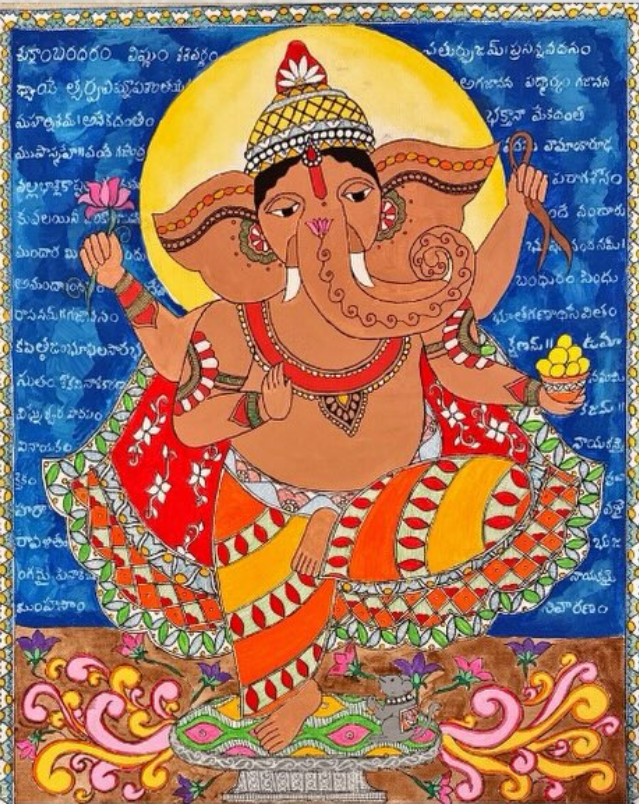
Artwork by youth artist Anika Adusumelli.
Traditions
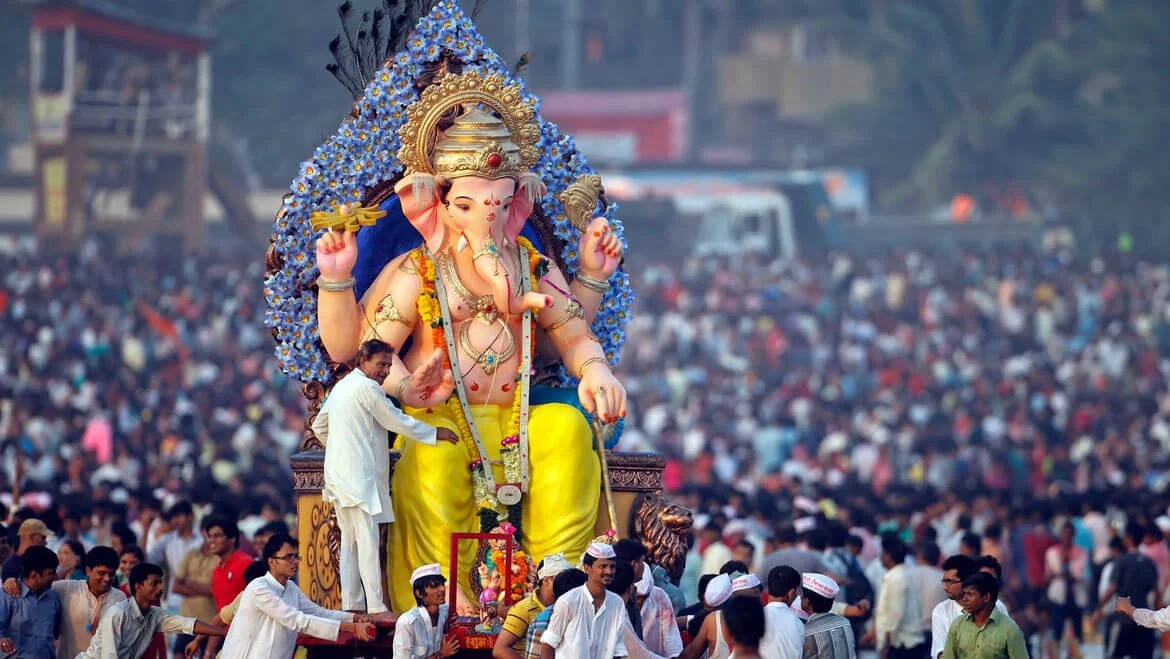
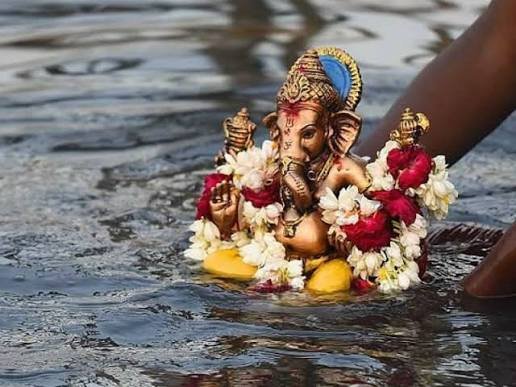
Ganesh Chaturthi marks the auspicious birth of Lord Ganesha. The grand celebration begins by welcoming a handcrafted clay idol of Ganesha into your home. Devotees joyfully welcome their beloved Ganesha to their home as a guest. Throughout Ganesha’s stay, traditionally spanning 1.5, 3, 5, 7, or 11 days the members of the house keep him with utmost care and respect. Devotees offer daily prasad (sacred offerings) and perform aarti (devotional songs) filling the energy with joy, gratitude, and prayers for prosperity. The festival concludes with an event called visarjan. In a grand, high-energy parade filled with music, dance, and pure devotion, the idol is carried to a nearby river, lake, or sea to be immersed. Thus, devotees pray and wait for the next time they will be able to welcome and celebrate Ganesha.