

Stories Behind the Canvas: Folk Art & Formulas

By Shriya Shaji and Hansika Senthil

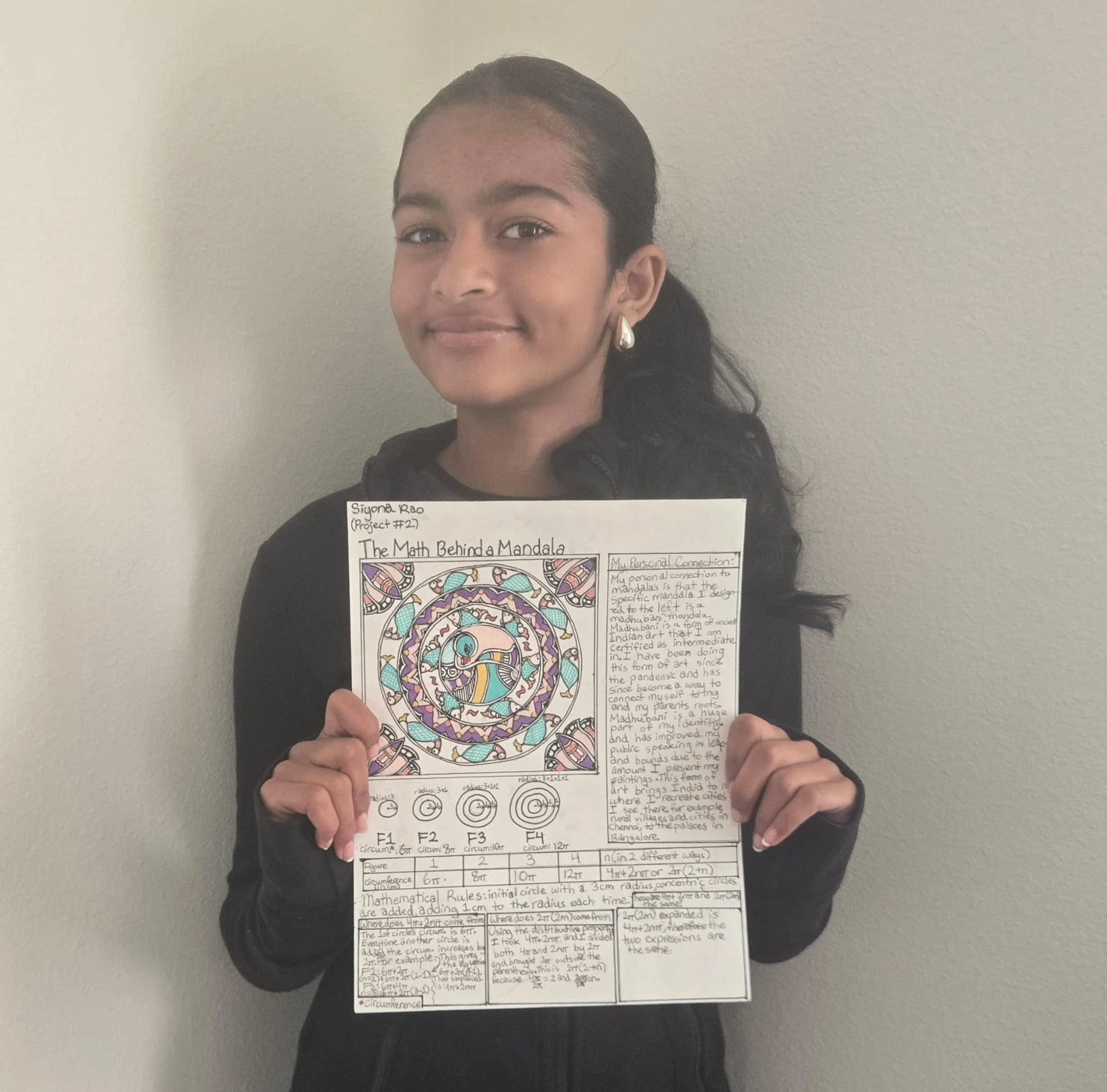
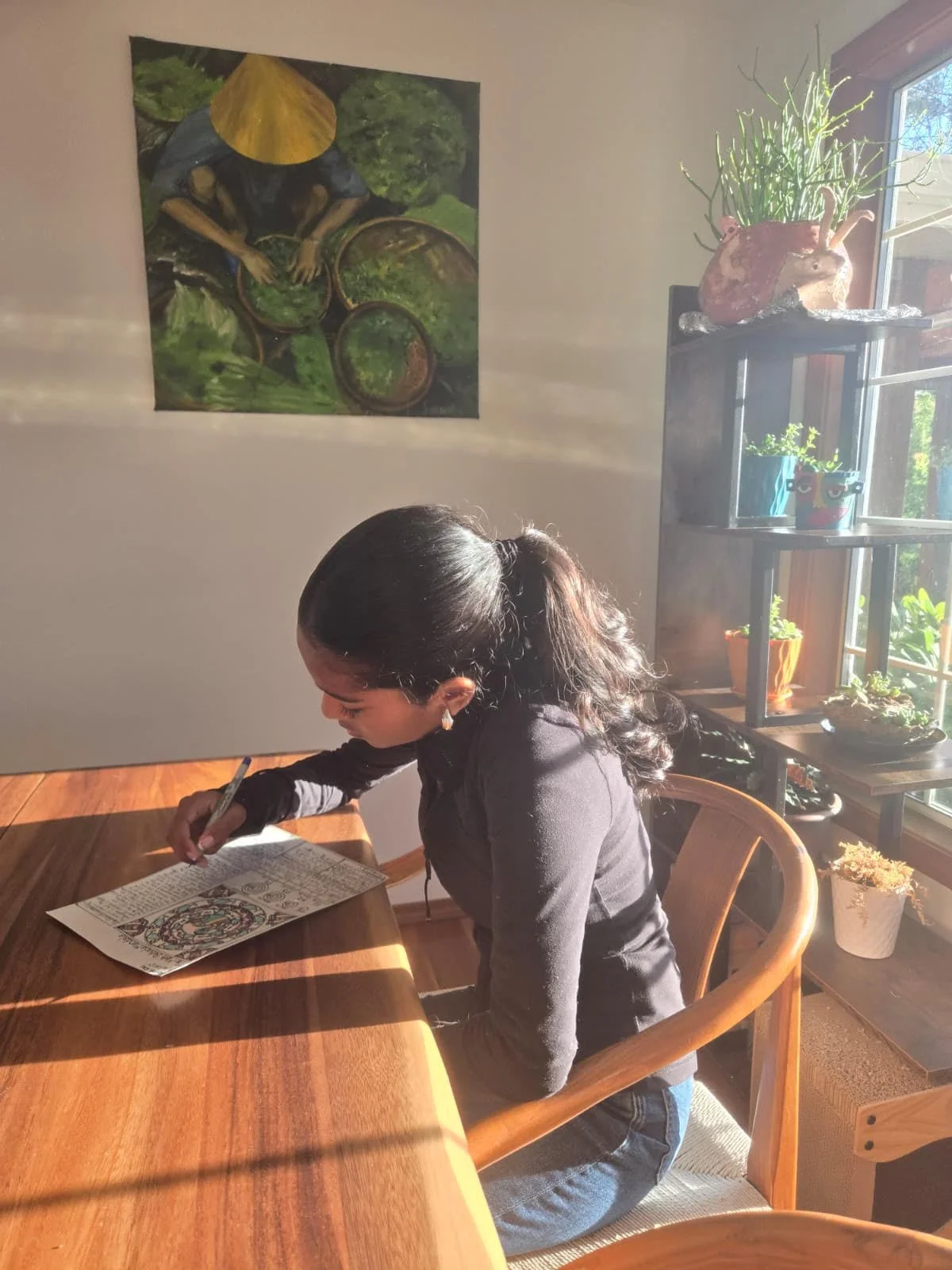
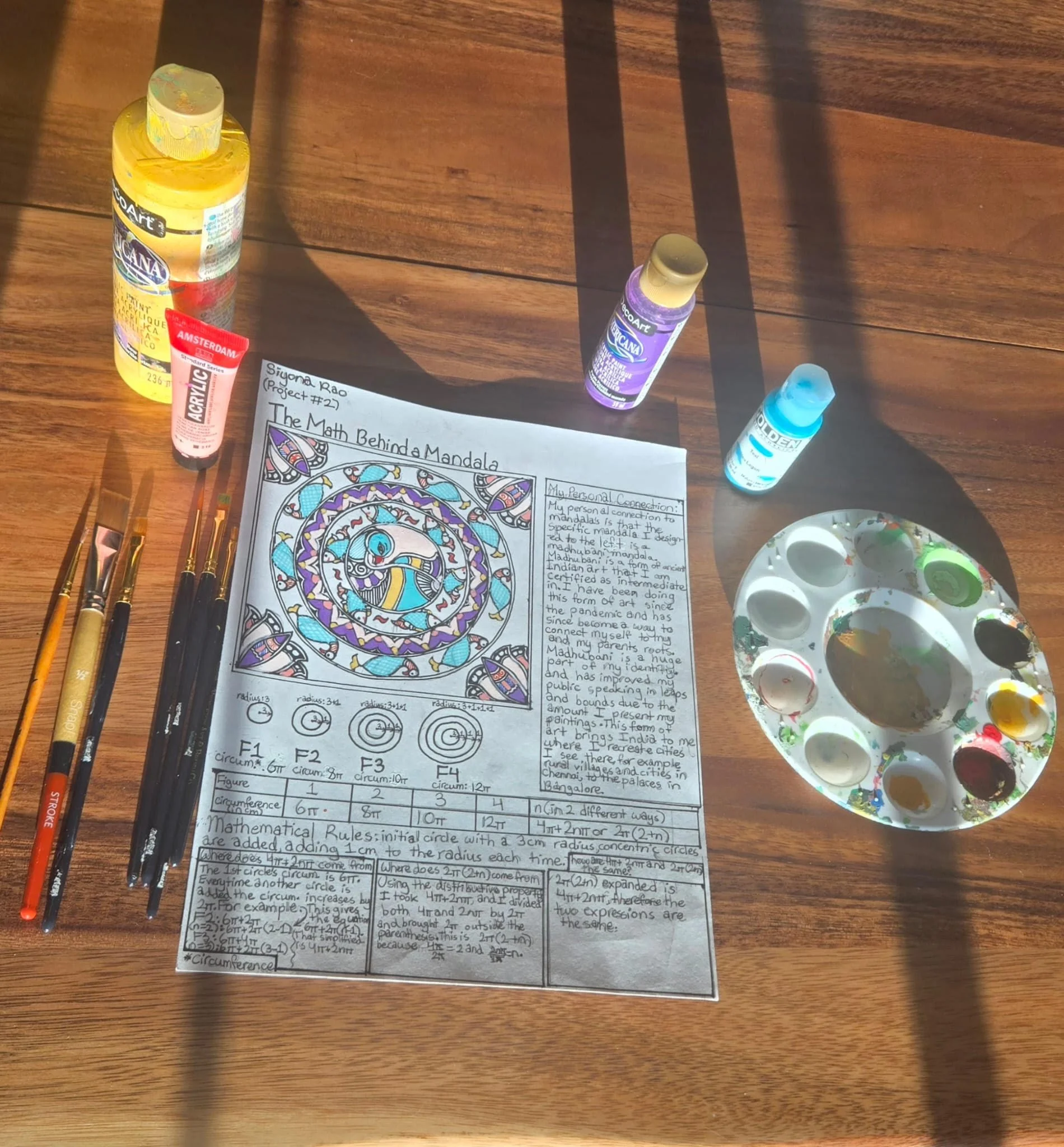
This month, we spoke to Siyona Rao, a youth artist who created an intricate Madhubani mandala art piece, inspired by a mathematical rule. Siyona discusses her thought processes, the formulas behind her work, and her goal to help others see the beauty behind math, and the beauty we can create using math.
Q&A with Siyona

What inspired you to use art to represent a math concept?

“I was given a math project about using math to create a visual pattern that changes according to a consistent mathematical rule. Immediately, I knew that I wanted to use a pattern that was personal to me. Then it hit me that I could use Madhubani art in my piece! There are so many beautiful, geometric patterns to choose from. Madhubani is such an intricate and interesting artform by itself, but fascinatingly it also has math woven in. I wanted to show that math can be beautiful too!”


We noticed you decided to represent the formula through a mandala; how did you make that decision?

“ I was looking through all my paintings trying to find a favorite of the mathematical patterns. I spent time scouring over Jodha Pathi, the proportions of the human figures, and others until my eyes finally landed on the mandala. It's the most perfect example of math in Madhubani. The concentric circles are beautiful and meticulously measured. I thought it would make for a great representation of math.”


Could you walk us through the mathematical concept you used in your mandala?

“I started by designing the mandala, specifying a mathematical rule. The mandala started with an initial circle with a 3 cm radius, and with each concentric circle I increased the radius by 1 cm. My goal was to develop a mathematical formula for measuring the circumference of the circle, whether it is four concentric circles or 400. Since the circumference of the first few circles can be computed, I looked for a pattern of how the circumference of the mandala increases with every additional circle. Finally, I was able to develop a formula to measure circumference for the nth circle.


You represented the concept of nth growth in relation to a circle’s circumference through art; how did that change, or improve your understanding of the concept?

“I definitely understood concepts much better. Art has always helped me grasp math concepts better. When I was younger, I used artwork to help me remember my math. Instead of counting on my fingers, I would draw cats and dogs and count them. I would write a number and turn it into a bird or a flower. This has definitely improved my relationship with math in the long run.”


What do you hope others take away from seeing the connections we can create between math and art?

“I hope that others take away from my piece that math can be used to create something beautiful. Math may seem complex and hard to understand, but really, it's everywhere. You do math every day, and don't even realize it. I hope that others who view math as daunting now see it as as something that shapes our world, can solve global problems, and makes our world a more beautiful place.”


Previous
Previous

Featured Paintings

Next
Next

Vyakhya Wordle Game