

What is Navratri?
By Aadya Bommineni, Aradhna Praveen, and Shriya Shaji
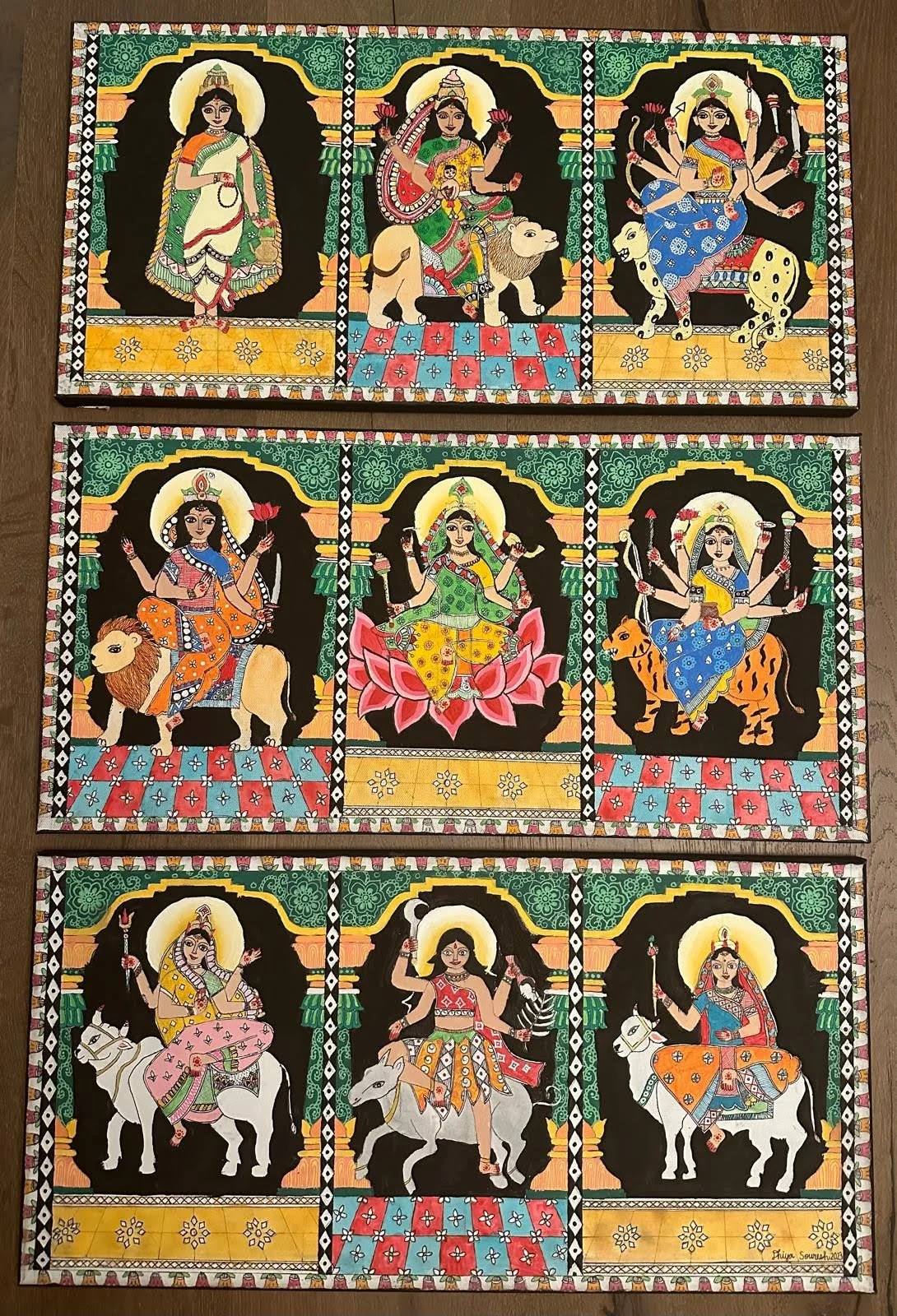
Read more to learn about Navratri, the festival dedicated to celebrating the divine female goddesses in Hinduism. We also feature artwork of the Navdurgas from Dhiya Souresh, a 9th grader from Bothell High School.
Background
Navratri is one of the most celebrated and beloved Hindu festivals throughout India, honoring the Navdurga, the nine incarnations of the mighty mother and warrior goddess Durga Maatha. There are multiple similar festivities that occur throughout the year during different seasons, but the most prominent one is Sharad Navaratri, celebrated in late fall and early winter. Navratri lasts for nine days, each day celebrating one avatar, and the day after Navratri, Dussehra, is the most prominent. Popular traditions include fasting, having pujas, dances that symbolize the cycle of life, and sculpting idols of the goddess to worship.
Story
The festival is a celebration of good over evil when Durga Maatha defeated Mahishasura, an evil demon. Mahishasura, a pious devotee of Lord Brahma, was granted a boon that no man could kill him, and using this boon he was wreaking havoc on Earth. The gods and goddesses focused all of their celestial powers to create Durga Maatha, a powerful goddess to defeat him. She rode her lion into battle to find Mahishasura. The two fought for nine days, which is celebrated as Navratri. On the 10th day (Dussehra), Durga Maatha beheaded him with her trident and successfully killed him as she was a goddess and not a human.
Significance
Navratri’s significance in Hindu culture portrays the idea of good over evil and honors “Shakti”, Sanskrit for the sacred energy of women. The festival celebrates women and feminine power. Since each goddess in the Navdurga has their respective virtue and symbolism, they have a night of Navaratri that represents each one of them. The 10th day of Navratri honors Adi ParaShakti, the final form of Durga that defeated Mahishasura. Fittingly, she is the most powerful Durga, a combination of all the Navadurga including their virtues and strength.
Shailputri
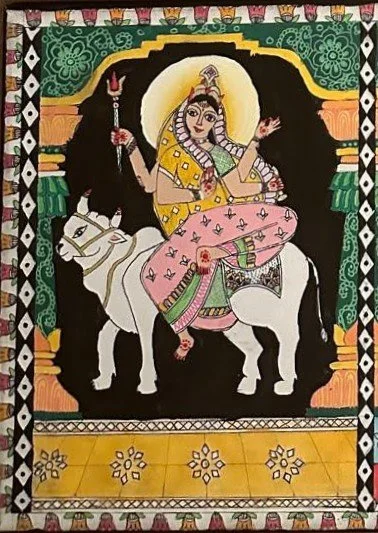
The first day of the festival of Navratri revolves around Goddess Shailputri, who is the first incarnation of Goddess Durga. Her name literally means the daughter of the mountain, as she is the daughter of the king of the Himalayas. In artwork, Goddess Shailputri is depicted riding a sacred bull (named Nandi), while holding a trident and a lotus flower. Shailputri is worshipped on the first day of Navratri and she embodies the qualities of strength and stability, represented by her riding a bull.
Brahmacharini
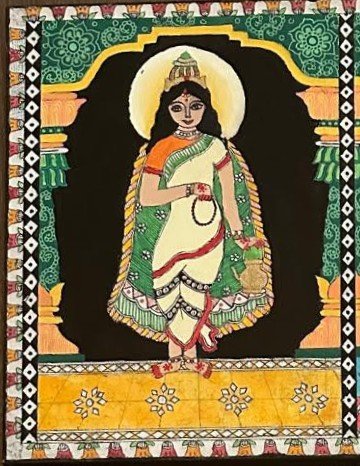
Goddess Brahmacharini is the second form of the nine incarnations of Goddess Durga. She represents devotion, focus, discipline, intellect and determination. For several years, Brahmacharini practiced yoga, meditation and performed rigorous spiritual rituals, in pursuit of enlightenment. Her story holds relevance, as women have been denied freedoms to pursue spirituality, yet Bharmacharini attained enlightenment. Goddess Brahmacharini is often depicted clothed in white, holding a mala (similar to a rosary and necklace, a string of prayer braids) in one hand and a sacred water pot in another. She is depicted standing on bare feet.
Chandraghanta
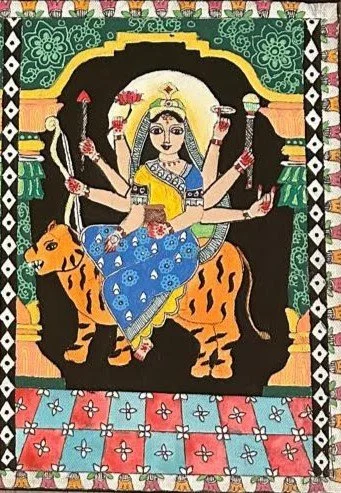
Chandraghanta is the third form of goddess Durga. After Brahmacharini married Lord Shiva, she became known as Goddess Chandraghanta. She rides a tiger and is depicted with ten hands. Each hand carries a trishul (trident), gada (mace), sword, kamandal (a sacred water pot), lotus flower, and a bow and arrow. Her other two hands, are oriented in mudras (hand gestures). She holds one to remove doubt and fears, and a blessing mudra. Goddess Chandraghanta took on this form when villages were tormented by the armies of a powerful asura named Jatukasura. She destroyed his army, and restored peace. She symbolizes leadership and courage, through her actions as well as her symbolic appearance.
Kushmanda
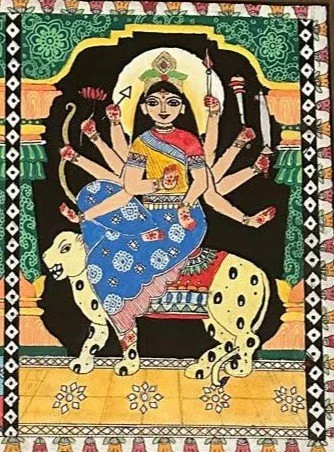
Goddess Kushmanda is worshipped on the fourth day of Navratri. She is known to be one of the creators of the universe. Initially, the cosmos existed in darkness in an unbroken silence. It is believed that Goddess Kushmanda’s smile is to have brought light and energy to the cosmos, allowing plants and animals to thrive. She symbolizes energy, happiness, and vitality as she is the source of energy, light, warmth, clarity and life. She lives in the sun’s core, directing the Sun God, Surya to shine brightness on Earth. In each of her eight arms, she carries a kamandal (water pot), a rudraksha mala (a necklace made from the seeds of the Rudraksha tree), a chakra (wheel), a lotus, a gada (mace) and a bow and arrow and is depicting riding a lion or tiger.
Skandamata
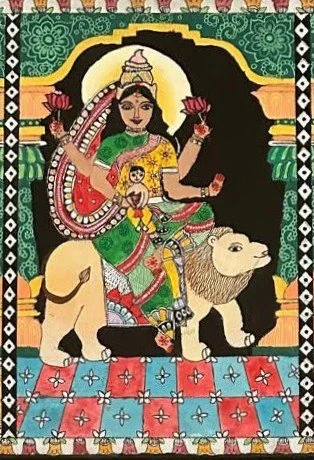
Goddess Skandamata is the fifth from of Goddess Durga, her name meaning the “Mother of Skanda”, Skanda being Lord Murugan who is known by various names. An demon named Tarakasura, tormenting the gods was granted the boon that he could only be defeated by a child of Lord Shiva. Lord Shiva and Goddess Skandamata put forth their strength and energies which combined to form a fireball. The child which emerged from this fireball came to be known as Skanda, who did indeed defeat named Skanda was born from Shiva and Parvati’s strength to defeat the demon Tarakasura with the help of his mother, Skandamata. She is depicted seated on a lion, cradling her child Skanda (Murugan). She holds lotus flowers in two hands, and one holds her child, and the other hand holds the abhay mudra, to bestow devotees with protection, peace and kindness.
Katyayani
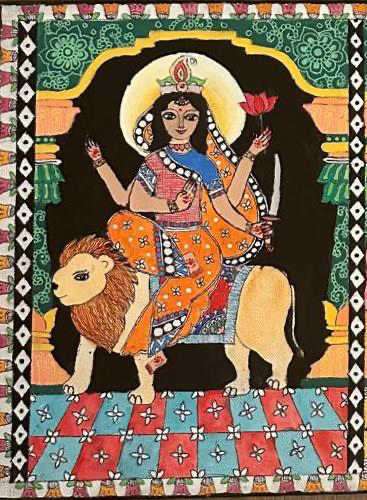
Goddess Katyayani is the sixth form of Goddess Durga representing the warrior goddess. Goddess Katyayani defeated the demon Mahishasura, harnessing her emotions of anger for her advantage, hence she represents a warrior. In her four hands, she holds a lotus, sword and the varada and abhay mudra, bestowing blessings. She rides a bull.
Kalaratri
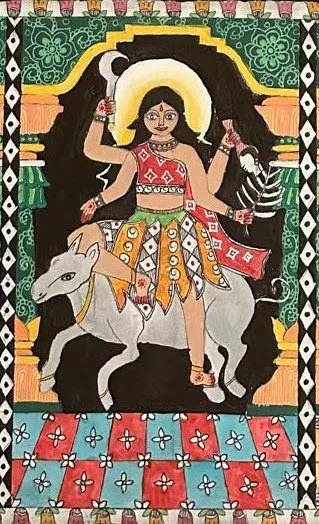
Goddess Kalaratri, is the seventh form of Goddess Durga, one of the most ferocious and destructive avatars. Goddess Kalaratri defeated a formidable demon warrior named Raktabeeja, who had a blessing that each drop of blood which fell to the ground would produce new armies. Goddess Kalaratri swept the drops of blood with her tongue to prevent them from falling to the ground, and fought and defeated the demon and his armies. Goddess Kalaratri is also another form of Goddess Parvati, she also plays the role of Lord Shiva’s wife. In artwork she is portrayed with dark blue skin, disheveled hair and sometimes a necklace of skulls adorns her neck. In her hands, she carries a Vajrayudha (a thunderbolt weapon made from the bones of a sage) and a short curved blade, and her other hands oriented in mudras. She mounts on a donkey, and similar to Lord Shiva, she wears tiger skins.
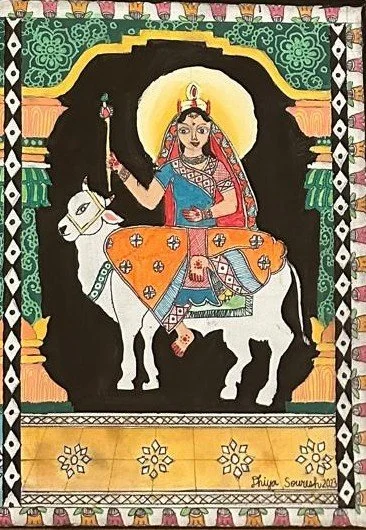
Mahagauri
Goddess Mahagauri is the eight form of Goddess Durga and her name relates to “purity” or being “extremely fair.” Goddess Mahagauri mounts on a cow and carries a trishul, damaru (a small drum associated with Lord Shiva) and orients her other two hands in mudras. It is believed that praying to her brings clarity to the mind and soul.
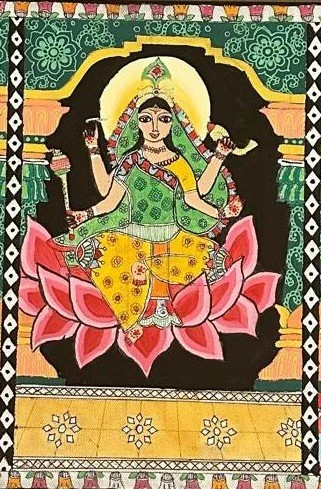
Siddhiratri
Goddess Siddhiratri, is the ninth and final form of Goddess Durga. Her name is composed of two words “perfection bestower” or “perfection giver.” She granted the Ashtasiddhis (eight perfections) to Lord Shiva, which include the abilities to change size and fulfill and control any desires. In artistic depictions, Goddess Siddhiratri is portrayed in red or pink clothing, seated on a lotus, holding a lotus, a conch shell, a mace and a chakra in her hands.
